
What are the basic parts of ammunition?
Learn the basic parts of ammunition, including the bullet, cartridge case, primer, and propellant. Simple explanation of ammunition components for beginners.
12/27/20255 min read
Ammunition is more than something that goes into a firearm. It is a carefully built assembly of parts that work together in a precise order. To understand firearms, safety, or performance, you need to know what the basic parts of ammunition are.
Many people use the word “bullet” to describe the entire round. That is inaccurate. A bullet is only one part of ammunition. The complete unit is called a cartridge. Each cartridge contains several components, and each one has a specific job.
Knowing the basic parts of ammunition helps you make better decisions. It improves safety. It also makes it easier to choose the right ammo for training, hunting, or range use. You gain clarity on how different bullet parts affect accuracy, recoil, and reliability.
This guide breaks everything down in plain language. You will learn the anatomy of a bullet, the parts of a cartridge, and what bullets are made of. No filler. Just clear explanations.
Educational resources like GearOps Review often stress understanding equipment before use. Ammunition knowledge is part of that foundation.
What Is Ammunition Made Of?
Ammunition is made of several materials working together in a controlled sequence. Each material serves a specific role. Together, they create a single cartridge.
At its core, ammunition includes metal, chemical compounds, and sometimes polymer coatings. The most visible part is the bullet. Bullet composition often includes lead, copper, or a combination of both. Some bullets use solid copper. Others use jackets that surround a softer core.
The cartridge case is usually brass. Steel and aluminum are also used. Brass remains common because it expands and contracts in a predictable way during firing. That behavior helps with reliability.
Inside the cartridge is the propellant. This is commonly called gunpowder. It is not explosive in the traditional sense. It burns rapidly. That controlled burn creates expanding gas, which pushes the bullet forward.
At the base of the cartridge sits the primer. The primer contains a small amount of impact-sensitive compound. When struck, it ignites the propellant.
Understanding what bullets are made of helps explain performance. Weight, material, and internal design affect speed, penetration, and recoil. These details also explain why different ammunition behaves differently in the same firearm.
The Difference Between a Bullet and a Cartridge
The terms “bullet” and “ammunition” are often used interchangeably. That causes confusion. They are not the same thing.
A bullet is the projectile. It is the part that exits the barrel. It is only one component of ammunition.
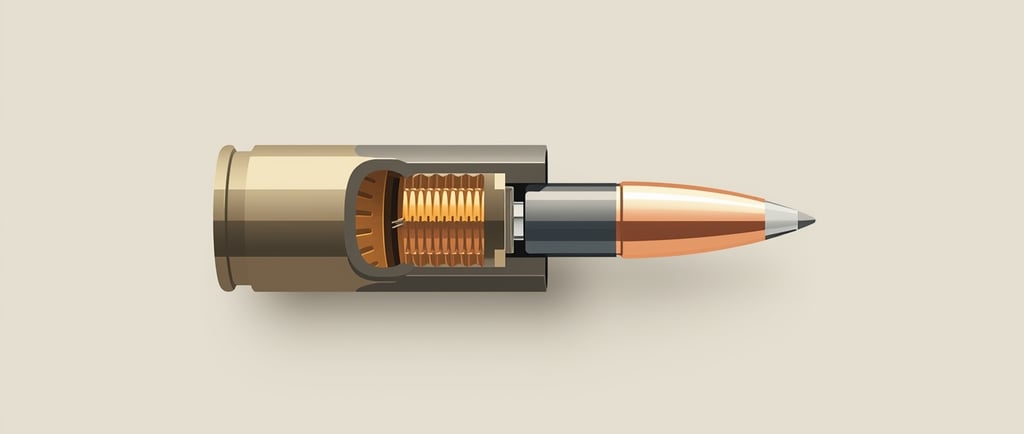
A cartridge is the complete unit. It includes the bullet, the cartridge case, the primer, and the propellant. When people refer to the basic parts of ammunition, they are describing the parts of a cartridge.
Think of the cartridge as a container. The bullet sits at the top. The propellant fills the case. The primer sits at the base.
This distinction matters. Many safety rules, storage guidelines, and performance discussions rely on proper terms. Mislabeling parts can lead to misunderstandings, especially for new shooters.
When reviewing bullet parts, you are focusing only on the projectile itself. When reviewing parts of ammunition, you are examining the entire system. Both perspectives are important.
Anatomy of a Bullet (Bullet Parts Explained)
The anatomy of a bullet describes the physical structure of the projectile. Bullet anatomy varies by design, but most bullets share common elements.
The tip is the front of the bullet. It may be rounded, pointed, hollow, or flat. The shape affects how the bullet travels and what it does on impact.
Behind the tip is the core. In many designs, the core is lead. Lead is dense and malleable. Some bullets replace lead with solid copper or bonded materials.
Many bullets include a jacket. The jacket is a thin metal layer, often copper, that surrounds the core. It helps the bullet maintain shape and reduces barrel fouling. This is a major part of modern bullet composition.
The base is the rear of the bullet. Some designs include a flat base. Others use a boat-tail shape, which narrows at the rear to reduce air resistance.
If you looked at the inside of a bullet, you would see how the core and jacket interact. Some designs lock the core to the jacket. Others allow separation. These choices affect penetration and expansion.
A bullet diagram often labels these features. Diagrams help visualize how bullet parts work together. While bullets vary widely, the basic anatomy remains consistent across most types.
Basic Parts of Ammunition (Complete Breakdown)
To fully answer what are the basic parts of ammunition, you must look at all components of a cartridge. Each part plays a specific role during firing.
Bullet
The bullet is the projectile. It travels down the barrel and toward the target. Bullet parts include the tip, core, jacket, and base. The bullet does not contain powder or primer.
Cartridge Case
The cartridge case holds everything together. It houses the propellant and supports the bullet. The case also seals the chamber during firing. Brass is common because it handles pressure well.
Primer
The primer is a small metal cup located at the base of the cartridge. Inside is a sensitive compound. When struck by the firing pin, it ignites. That ignition starts the firing sequence.
Propellant
The propellant sits inside the case. It burns rapidly when ignited by the primer. The expanding gas pushes the bullet forward. Different propellants burn at different rates.
These are the basic parts of ammunition found in nearly all modern cartridges. Removing or altering any one part stops the system from working.
Understanding these parts of ammunition helps with troubleshooting. It also helps explain why certain ammo performs better in specific firearms.
Educational sites like GearOps Review often highlight how small components affect overall performance. Ammunition is no exception.
Parts of a Cartridge Explained Simply
The parts of a cartridge function in a precise order. Each step depends on the previous one.
First, the firing pin strikes the primer. The primer ignites instantly.
Next, the primer flame travels through the flash hole into the case. This ignites the propellant.
As the propellant burns, gas expands. Pressure builds rapidly inside the cartridge case.
That pressure pushes the bullet out of the case mouth and into the barrel. The case expands slightly, sealing the chamber.
Once the bullet exits the barrel, pressure drops. The case contracts. This allows extraction in repeating firearms.
This sequence explains why cartridge design matters. Small differences in bullet components or propellant type change how the system behaves.
What Bullets Are Made Of and Why It Matters ?
What bullets are made of affects nearly every aspect of performance. Material choice changes weight, hardness, and deformation.
Lead bullets are heavy and soft. They deform easily. Copper bullets are lighter and harder. They retain shape better.
Jacketed bullets combine materials. The jacket controls friction. The core controls mass.
Bullet composition also affects safety and legality. Some ranges restrict exposed lead. Some regions regulate specific materials.
Understanding bullet composition helps match ammunition to purpose. Training, hunting, and target shooting all benefit from different designs.
Bullet Diagram and Visual Explanation
A bullet diagram helps clarify structure. Most diagrams label the tip, jacket, core, and base.
Cartridge diagrams add the case, primer, and propellant. Together, these visuals show what is in a bullet versus what is in ammunition.
Diagrams simplify learning. They reduce confusion between bullet anatomy and cartridge anatomy.
Even without images, understanding labeled components improves comprehension of how ammunition works.
FAQ: Basic Parts of Ammunition
What are the basic parts of ammunition?
The basic parts of ammunition are the bullet, cartridge case, primer, and propellant. Together, they form a cartridge.
Is a bullet the same as ammunition?
No. A bullet is only the projectile. Ammunition refers to the complete cartridge.
What is inside of a bullet?
Inside of a bullet is typically a core made of lead or copper. Some bullets include bonding or layered materials.
What is in a bullet versus a cartridge?
A bullet contains no powder or primer. A cartridge contains the bullet plus all ignition components.
Why does bullet anatomy matter?
Bullet anatomy affects accuracy, penetration, and recoil. Shape and materials change how bullets behave in flight and on impact.
Are all parts of ammunition the same across calibers?
The basic parts of ammunition are the same, but size, material, and design vary by caliber and purpose.